
Photo credits: © The Commonwealth via Flickr (CC BY-NC 2.0)
Citizen election observers, formally recognised as human rights defenders, legitimise elections, build public confidence, support democratic consolidation, improve electoral administration. However, their work is increasingly challenged by the global rise of authoritarianism and major cuts to international democracy assistance. To sustain resistance and remain resilient under restrictive conditions, they must adjust their strategies and develop innovative methodologies to operate under increasingly restrictive conditions, while continued and adapted support from the EU and other donors remains essential to protect citizen election observation.
Introduction
Elections form the backbone of democratic governance, yet their integrity must be safeguarded. Across the globe, citizen election observers play a key role in protecting democratic processes as independent actors who document electoral conduct, expose irregularities, recommend reforms, and hold governments accountable to international standards. Through systematic observation and reporting, these civil society actors assess whether states comply with their obligations regarding genuine democratic elections and the protection of fundamental rights and freedoms. Reflecting their work in collecting and disseminating information on election violations, supporting accountability, and contributing to the implementation of human rights treaties, election observers are now formally recognised as human rights defenders. In October 2025, the African Commission on Human and Peoples’ Rights adopted a resolution recognising civilian oversight, through citizen observers, as an important pillar of electoral integrity.
For nearly three decades, citizen election observers have operated in increasingly constrained civic space. Today, they face a new challenge. Not only pressure from authoritarian regimes and potential autocrats, but, paradoxically, from democratic countries themselves, which have dramatically reduced democracy assistance. The closure of the United States Agency for International Development (USAID) and concurrent funding cuts by other donors have had a significant impact on CSOs worldwide.
Against the backdrop of a global decline in democracy, this spotlight examines the increasingly threatened role of citizen election observers. It explores how they contribute to transparency and electoral accountability, and argues that protecting and supporting citizen election observation must remain part of international efforts to promote democracy. As observers are recognised as human rights defenders under international law, safeguarding their work is not merely a matter of electoral integrity, but a fundamental human rights obligation.
The role and Functions of Citizen Election Observers for Democratic Resilience and Electoral Integrity
Citizen election observers are non-partisan monitors organised by civil society organisations and citizen groups who observe elections in their home countries, distinguishing them from international observers who monitor elections abroad. They operate independently of political parties, state institutions, media, and electoral authorities. While their primary focus is election observation, many of these organisations engage in broader civic activities beyond electoral cycles. Within the electoral context, citizen observers perform diverse functions: they document malpractices, train volunteer monitors, assess compliance with electoral regulations, and advise on legislative and procedural reforms. The International Institute for Democracy and Electoral Assistance (International IDEA) identifies five key contributions of citizen election observation: legitimising elections through independent verification, building public confidence in electoral outcomes, supporting democratic consolidation, improving electoral administration through constructive feedback, and reducing election-related conflict through transparent monitoring.
Citizen election observers are now formally recognised as human rights defenders in recognition of their role in protecting fundamental civic and political rights. Through their monitoring activities, they help safeguard the right to vote and stand for election, as well as essential freedoms including assembly and association, expression, access information, movement, and non-discrimination. In Africa, the African Charter on Human and Peoples’ Rights (Article 13) guarantees the right of every citizen to participate freely in government, while the African Charter on Democracy, Elections and Governance (Article 22) obliges states to create “a conducive environment for independent and impartial national monitoring or observation mechanisms.” By engaging in election dispute resolution processes, observers further support the right to access courts and other effective remedies. This international and regional recognition underscores that credible elections rely not only on technical administration, but also on the protection of human rights throughout the electoral cycle.
The Global Spread of Citizen Election Observation in Support of Democracy and Electoral Integrity
The modern practice of citizen election observation has emerged as an integral component of the third wave of democratisation that swept the globe in the 1980s and 1990s. The Philippines served as a pioneering example when citizen observers played a crucial role in the 1986 Filipino election, with the National Citizens’ Movement for Free Elections (NAMFREL) mobilising over 500,000 volunteers to monitor the presidential election. This success inspired replication worldwide. Throughout the 1990s and 2000s, domestic observation networks proliferated across Latin America, Eastern Europe, Africa, and Asia. Citizen election observers are now professionally organised within a global network, the Global Network of Domestic Election Monitors (GNDEM), along with several regional citizen observer networks. Such regional networks in Africa include the East and Horn of Africa Election Observers Network (E-HORN), the Election Support Network of Southern Africa (ESN SA), and the West African Observers Network (WAEON), all organised under the umbrella of the African Election Observers Network (AfEONet) and the Election Network in the Arab Region (ENAR). Citizen election organisations have developed increasingly advanced methodologies, evolving from mere election-day monitoring to comprehensive long-term observation, which has encompassed voter registration, campaign conduct, media coverage and post-election dispute resolution. Professional training programmes have emerged, alongside the adoption of standardised observation forms and statistical sampling techniques. Today, citizen observers operate in dozens of countries, representing civil society’s frontline defence of electoral integrity. Their work is guided by the Declaration of Global Principles for Non-Partisan Election Observation and Monitoring by Citizen Organizations and the Code of Conduct for Non-Partisan Citizen Election Observers.
The Backlash against Citizen Election Observers and Electoral Integrity
Democracy and democratic actors now face two significant challenges globally. Firstly, the global trend of increased authoritarianism, characterised by the gradual erosion of democratic institutions and norms, has fundamentally altered the electoral environment. Potential autocrats and illiberal leaders increasingly exploit elections as tools to legitimise their power, rather than as mechanisms for democratic choice. This is achieved through systematic manipulation, including the use of restrictive legal frameworks, the misuse of state resources, media control, voter intimidation, and the targeted repression of opposition actors. In this hostile context, citizen election observers have themselves become primary targets. Governments seeking to operate without independent scrutiny impose burdensome accreditation requirements, deploy harassment and intimidation tactics, enact restrictive ‘foreign agent’ legislation and restrictions on foreign funding, and, in extreme cases, resort to violence or outright bans on observation activities. Further, fewer countries invite credible international observers, while some cynically deploy government-friendly ‘zombie observers’ to lend false legitimacy to flawed electoral processes, all the while cracking down heavily on the electoral environment and citizen election observers.
Citizen Election Observers in Uganda
On December 30, 2025, just sixteen days prior to Uganda’s general elections on January 15, security forces arrested Dr Sarah Bireete, one of Africa’s most prominent election observers and human rights defenders. Dr Bireete serves as the Executive Director of the Centre for Constitutional Governance (CCG) and is the chair of both the GNDEM and E-HORN. Ahead of the elections, in which President Yoweri Museveni, who has been in power for nearly four decades, faced opposition challengers, Dr Bireete had publicly expressed concerns regarding electoral legitimacy and potential discrepancies in Uganda’s voter register.
Dr Bireete was charged with “unlawfully obtaining or disclosing personal data” regarding voter information, which is data routinely provided by the Electoral Commission to political parties and candidates. Her bail hearing was deliberately scheduled after election day, preventing her from voting, observing, or commenting on the electoral process. The arrest occurred amid a broader climate of systematic repression, election violence, and deepening autocracy. As part of the targeted violence against the opposition, multiple CSOs were suspended, their bank accounts frozen, and opposition figures threatened, while internet shutdowns began on January 13. In the post-election environment, security forces raided the home of the main opposition candidate, Bobi Wine, who managed to escape. Dr Bireete was granted bail on January 28 and is now facing a legal battle.
Secondly, the broader backlash against development aid and democracy support among Western donors has created an increasingly precarious funding environment, as a considerable number of citizen observation groups are heavily reliant on international support for the continued facilitation of their operational activities. The sector has long been the recipient of significant financial and technical assistance from the United States, a longstanding leader in global election observation initiatives. The closure of USAID, in conjunction with further reductions in funding for development aid and democracy support by Western donors, has given rise to significant concerns regarding the sustainability of citizen observation initiatives. For example, Official Development Aid (ODA) experienced decreases of at least 9 percent in 2024 and 2025 respectively, driven by cuts from four major providers: France, Germany, the United Kingdom, and the United States. In 2025, sub-Saharan African countries are estimated to have experienced a 16-28 percent decline in ODA.¹ CSOs are among the most vulnerable to these cuts, as 57 percent of their funding comes from the three main providers: the United States, Germany, and the European Institutions.
The most recent reductions in U.S. democracy assistance have devastated electoral support programmes worldwide. The scale of these cuts is unprecedented: nearly 70 percent of all U.S. government-funded Democracy, Rights, and Governance (DRG) grants have been terminated, affecting CSOs in over 120 countries. The impact on electoral assistance has been severe, with 97 percent of USAID-funded and 51 percent of State Department DRG electoral awards having been eliminated, resulting in the near-total collapse of U.S. electoral assistance. In total, an estimated $770 million in USAID-funded electoral assistance has been terminated.
The operational consequences for citizen election observers are immediate and severe, significantly impacting the quality and integrity of electoral processes. Citizen observation groups that previously engaged in capacity building programmes and deployed thousands of trained monitors now face the prospect of scaling back to reduced, selective, or even no coverage, leaving many constituencies unmonitored. In 2025, Zimbabwe experienced an 83 percent cut to USAID programmes, including funding specifically allocated for election observers. This had a direct impact on the Zimbabwe Election Support Network and other CSOs engaged in election observation. Certain funds previously allocated by USAID and implementing partners, such as the Carter Centre, for capacity building, training, and education were disbursed before the suspension, leaving organisations without resources (Interview, Focus Group 2026).² Similarly, voter education programmes were absent in Uganda during the 2025/26 general elections. Furthermore, Election Management Bodies (EMBs) have lost access to the technical expertise of electoral specialists, which is essential for inclusive electoral practices, particularly in ensuring the electoral participation of women and persons with disabilities, as well as for implementing necessary long-term electoral reforms and capacity-building programmes. Concurrently, the broader environment for civil society has deteriorated sharply. Citizen election observers now face multiple threats from both their own government and former democratic allies. These threats include restrictive ‘foreign agent’ laws, electoral malpractices, increased harassment targeting CSO leaders, and cyber threats. This combination of repression against citizen election observers and financial cuts poses an existential threat to organisational capacity and independence.
The strategic implications for democracy and democratic actors extend beyond individual organisations: “major institutions and intergovernmental organizations are scaling back missions, leaving domestic observers to shoulder greater responsibility in politically sensitive environments, often with reduced credibility and higher risks. Overall, these trends highlight a deterioration in election quality, weakened reforms and greater vulnerability to violence and authoritarian backsliding in those contexts”. The results of this dual retreat are a systematic deterioration in election quality, weakened prospects for democratic reforms, and increased vulnerability to electoral violence and authoritarian backsliding in precisely those contexts where independent election observation is most urgently needed.
Resilience and Resistance of Citizen Election Observers to Autocratisation
Citizen election observers have demonstrated a remarkable capacity to resist and adapt to the shrinking civic space and electoral restrictions. Their responses to illiberal policies encompass a variety of strategies, with the most effective for resistance being moderate and institutional, such as coalition-building, lobbying, and persuasion, which emphasise pro-democratic and anti-polarising values. As part of broader CSO coalitions, citizen election observers have played a crucial role in defeating restrictive NGO legislation in countries including Kenya, Kyrgyzstan, and Zambia, though in other countries, such as Kazakhstan and Uganda, the implementation of this law could not be prevented. In their role as democratic actors and ‘agents of resistance,’ citizen observers are more successful in overcoming restrictive electoral environments when they maintain access to public debate and policy processes. Beyond political strategies, the methodological adaptation of observation to counter shrinking civic space is equally important. Observers must modify their strategies, reporting mechanisms, and data collection methodologies to operate under increasingly restrictive conditions (Focus Group 2026).
Contributions of Citizen Election Observers to Transparency and Electoral Integrity in the Face of Restrictions
Tanzania’s October 2025 elections were held amid severe democratic regression. With opposition parties disqualified and civic space systematically restricted, the electoral environment was not free. Most critically, the government imposed a total internet shutdown during the elections. The African Union Election Observation Mission confirmed that this “limited election observers’ ability to fully observe and report on crucial elements of the election process.”. Faced with these constraints, the East and Horn of Africa Election Observation Network (E-HORN) and its member organisation, the Tanzania Bora Initiative, adapted by organising a remote Election Situation Room (ESR) instead of deploying ground observers. The remote ESR maintained election monitoring through media monitoring, open-source monitoring, reports from academia and local civil society, international observer updates, and verification through regional networks. This approach enabled E-HORN to maintain situational awareness, cross-check information, and provide transparency along with a local citizen perspective despite the restrictions on election day observation (Focus Group 2026).
The ability of citizen election observers to sustain resistance and remain resilient relies on a combination of international electoral assistance, formal electoral network structures, and the strategic decisions made by the election observers themselves. Given that election observation missions are resource-intensive, sustained financial support is crucial. This allows citizen observers to adapt and strengthen their methodologies in increasingly challenging electoral environments, including through the establishment of situation rooms and other innovative forms of observation, such as those demonstrated recently in Tanzania. The recent dramatic reductions in U.S. democracy assistance therefore do not only pose a threat to the existence of individual organisations, but also to the infrastructure of democratic accountability that observers provide.
Supporting Citizen Election Observers in Maintaining Electoral Integrity and Democratic Resilience
The withdrawal of U.S. funding and the rise of autocracy, coupled with the formal legal recognition of observers as human rights defenders, have created a critical juncture and led to a democratic paradox.
At this pivotal moment, as autocratic governments intensify their restrictions on civil society through ‘foreign agent’ laws and escalate repression against citizen observers, Western democracies are retreating from funding independent citizen election observers. This retreat undermines the operational capacity of citizen observers, who have recently been formally recognised as human rights defenders essential to electoral integrity, by the very democracies that champion their work.
The current retreat of the U.S. from democracy assistance presents both challenges and opportunities for the European Union (EU). European leadership is essential, not optional, for preserving the global capacity for independent electoral monitoring and for strengthening and maintaining their formal networking capacities and funding schemes. The question is not whether the EU and other Western donors should support citizen observers, but whether they will uphold their international legal obligations and strategic interests by providing effective support.
Recommendations
- As the withdrawal of democracy aid has a particularly heavy impact on the civic space and electoral environment in low-income, fragile, and restricted authoritarian contexts, the EU and bilateral donors should maintain funding schemes supporting citizen election observers in these settings. Priority should be given to strengthening national and regional networks of citizen observers, enabling cross-border learning, synergies, resilience, and positive democratic spill-over effects.
- The EU should continue to uphold its thematic funding schemes that are independent of bilateral programming. The EU and member states should maintain dedicated, multi-annual budget lines for citizen election observation. These funds should provide core organisational support enabling citizen-led observation groups to maintain organisational capacity between elections and to implement citizen-led election observation missions.
- EU funding should adapt to the deteriorating electoral and political environment. As ‘foreign agent’ laws proliferate and direct threats to citizen observer safety increase, financial and technical support packages should include security provisions, legal defence funds, and flexibility for organisations operating under repression.
- The EU, together with member states as bilateral donors, should continue to coordinate the international response to ‘foreign agent’ laws. As restrictive legislation proliferates, donors should develop coordinated strategies to support CSOs facing legal constraints on foreign funding and their operational freedoms. This includes exploring alternative funding channels, supporting legal challenges to restrictive laws, and imposing diplomatic costs on governments that violate international obligations to enable human rights defenders. As previous examples have shown, once such laws are in force, civic space deteriorates dramatically, along with electoral integrity.
- EU financial assistance must uphold the special status of election observers as human rights defenders and their obligations of impartiality and non-interference. Funding mechanisms should enhance observer independence from both donor governments and partisan political interests. This requires safeguards against conditionality that could undermine observer credibility.
¹ Figure 1 in the Annex provides an overview of the main ODA providers to African countries with the highest rates of extreme poverty.
² The author conducted a focus group interview with representatives of the AHEAD Africa project on January 28, 2026.
Annex
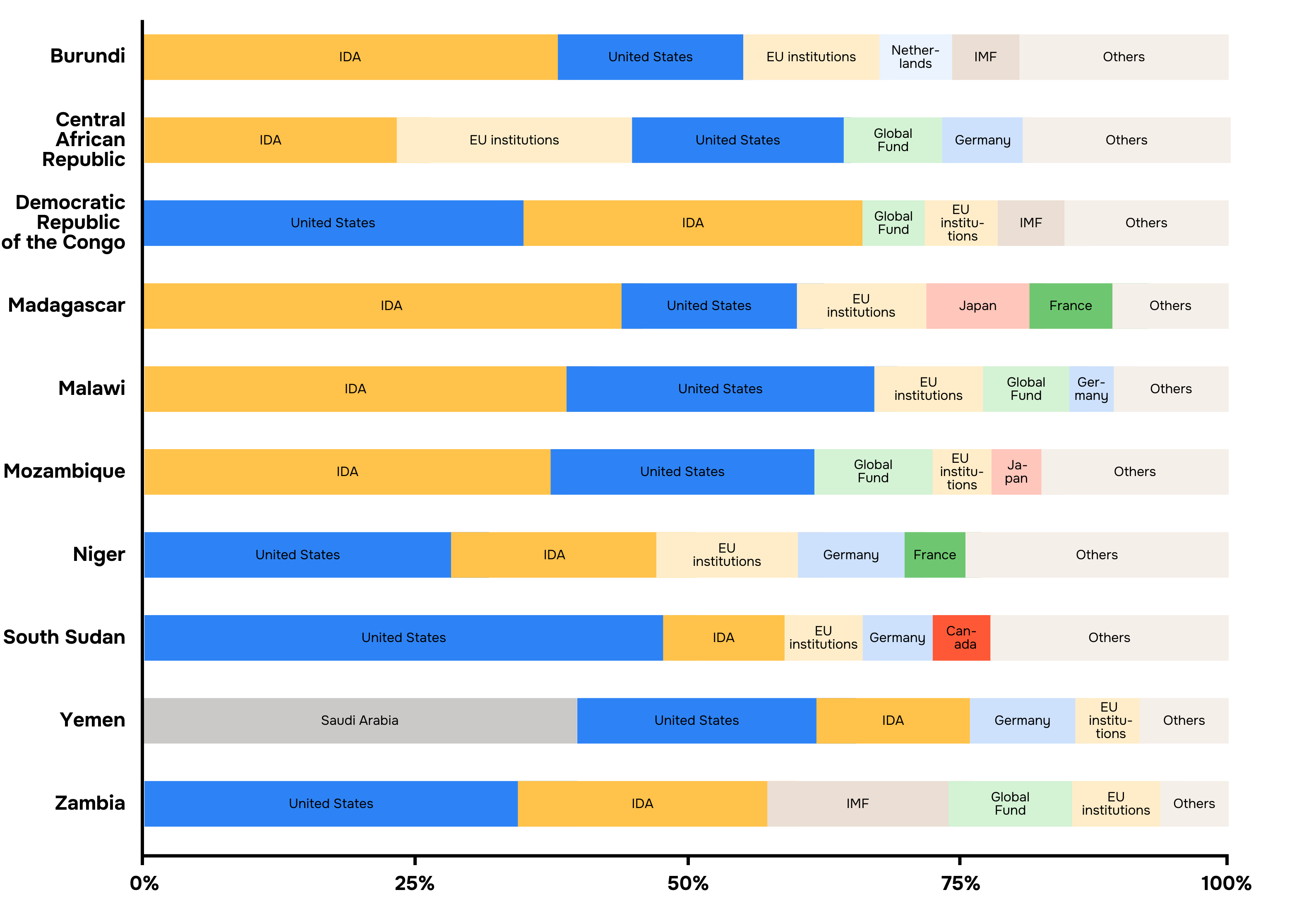
Figure 1. Major providers that have announced cuts, along with the multilateral organisations they support, are among the leading providers of concessional finance in the poorest countries. Share of total ODA received by the ten countries with the highest rates of extreme poverty (2023 projected), including the top five providers and other providers that report to the OECD. Source: Figure taken from the website of the OECD and World Bank.
